
October 28, 2026 · 10 min read
POWER IS THE NEW LOCATION, LOCATION, LOCATION
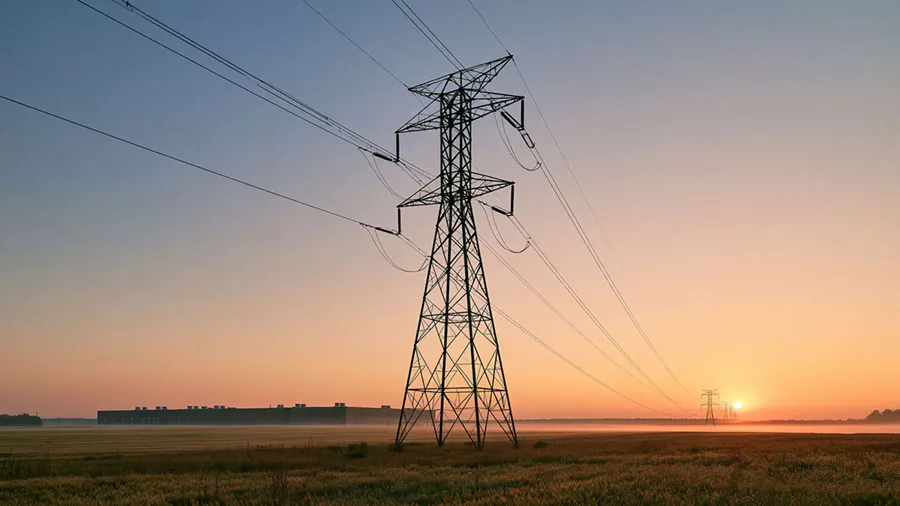
What Owners, Developers, and Brokers Need to Know About the Constraint Reshaping Commercial Real Estate
by Warren Tingen and Brett Hunsaker
For as long as any of us have been in this business, three words have governed every decision. Location, location, location.
That rule hasn't been repealed. But in 2026 it has a prerequisite.
Before a site can be judged on access, visibility, demographics, or labor, one question now comes first: can it get power, and when?
The artificial intelligence buildout has done something no previous cycle managed. It made electricity the scarce commodity in an industry that always treated electricity as somebody else's problem.
This is not only a data center story. It is reshaping industrial site selection, tenant operating expenses, entitlement risk, and the value of land nobody was tracking three years ago.
What Actually Changed
AI workloads concentrate enormous power into very little space. Conventional enterprise data halls were underwritten at roughly 5 to 10 kilowatts per rack. JLL's 2026 Global Data Center Outlook projects average rack density tripling to 45 kilowatts, with liquid cooling adopted in 80% of new facilities.
A single AI campus can require hundreds of megawatts of continuous load. Some exceed a gigawatt.
The grid was not built for that. Much of the American transmission system is fifty to seventy years old and was designed for gradual, predictable growth. It is now absorbing the fastest load increase since air conditioning went mainstream.
The result is a full inversion of how sites get selected. CBRE's 2026 outlook now names power availability and certainty as the top site selection criterion — ahead of location and ahead of cost. Developers are no longer optimizing for the cheapest kilowatt-hour. They are optimizing for the earliest date they can energize a building.
The Power Bottleneck by the Numbers
| Metric | Figure |
|---|---|
| Generation and storage capacity waiting in U.S. interconnection queues | 2,000+ GW |
| Average time in queue to commercial operation | ~5 years |
| Large-load requests in Dominion Energy's Virginia queue | ~70 GW |
| Portion of that queue with assigned connection dates through 2031 | ~25 GW |
| Projected average AI rack density | 45 kW |
| Data center projects blocked or delayed, Q1 2026 alone | 75 |
Sources: Lawrence Berkeley National Laboratory, Virginia State Corporation Commission filings, JLL, Data Center Watch
Time-to-Power Is the New Underwriting Metric
More capacity is sitting in U.S. interconnection queues than the country currently has installed. Wait times have more than doubled over the past fifteen years.
Virginia offers the clearest picture, because the numbers finally became public. In a February 2026 filing with the State Corporation Commission, Dominion Energy disclosed a large-load interconnection queue holding roughly 70 gigawatts of requests. About 25 gigawatts had been assigned projected connection dates running through the end of 2031. The remaining 45 gigawatts were still under study, with no connection date at all.
For scale, Dominion's entire system peaks at roughly 25 gigawatts across every customer it serves.
Bulk supply is only half the problem. Substation upgrades are multi-year projects on their own, and a deal can die at the distribution level even when regional capacity exists on paper.
For anyone underwriting, brokering, or developing, the practical takeaway is simple. A utility letter is no longer diligence.
A power-ready site file in 2026 should include:
- Current and forecasted load in the service territory
- Planned transmission upgrades affecting the zone
- Substation transformer capacity
- Queue congestion at nearby buses
- Large-load tariff exposure and cost-allocation risk
- Phasing options if full power arrives late
- Local opposition risk tied to energy and water use
Site selection has become grid strategy with a real estate wrapper.
Behind the Meter and the Powered Site
When the front door is blocked for five years, capital finds another door.
The most significant response has been the move to behind-the-meter generation — developers building or contracting their own power rather than waiting in line. The past eighteen months brought a wave of announced projects centered on natural gas, with smaller contributions from nuclear restarts, fuel cells, and battery storage.
Regulators are catching up. On December 18, 2025, FERC found PJM's tariff unjust and unreasonable as applied to co-located large loads and directed the nation's largest grid operator to write clear rules for data centers sited alongside generation, along with reforms to its behind-the-meter generation provisions. PJM filed its compliance proposal in February 2026. A broader national rulemaking on large-load interconnection remains pending.
The second response is a genuine adaptive reuse story. Shuttered paper mills, smelters, and legacy heavy industrial sites come with something greenfield land does not: existing interconnection, water rights, and electrical infrastructure already in the ground. Developers are acquiring and ground-leasing these properties specifically for the power that comes with them.
In our earlier article, What Are We Going to Do With a Million Obsolete Office Buildings?, we argued that obsolescence is usually the start of a property's next life rather than the end of its first. The same logic is now running at industrial scale — except the reuse value is measured in megawatts.
Georgia and the Southeast
Metro Atlanta has become one of the most active data center destinations in the country, and Georgia is a live case study in how a state absorbs this kind of growth.
Georgia Power's 2025 Integrated Resource Plan projected approximately 8,500 megawatts of load growth over six years. In December 2025 the Public Service Commission (PSC) approved close to 10,000 megawatts of new capacity. The utility has proposed more than 1,000 miles of new transmission lines over the next decade. As of an April 2026 report, 32 large-load customers had committed to roughly 15,600 megawatts, with 21 projects under construction.
One caution belongs alongside those numbers. Announced load is not delivered load. Testimony filed with the PSC noted that since the 2023 IRP update, thirty-three data center projects representing more than 11,300 megawatts of announced load had been removed from the pipeline. A meaningful share of what gets announced never gets built.
The policy fight has been equally active. The PSC froze Georgia Power base rates through 2028 and, in April 2026, approved rule and contract changes intended to ensure large-load customers pay their own way rather than shifting costs to residential and small business ratepayers. Critics argue the protections don't go far enough. Power bills and data centers became central issues in this year's PSC races.
The local politics have moved even faster:
- DeKalb County has had a moratorium in place since July 2025, extended repeatedly while the county drafts rules. In June 2026 the commission voted down its own proposed data center zoning ordinance.
- Coweta County adopted a unanimous 180-day moratorium and is drafting an ordinance limiting data centers to industrial districts with requirements covering buffering, noise, lighting, traffic, and utility capacity.
- Douglas County adopted a 90-day pause amid a cluster of pending projects.
- Atlanta has prohibited data centers within the Beltline overlay district since 2024.
Tennessee, the Carolinas, and West Texas are drawing similar attention for the opposite reason — available generation capacity and shorter paths to energization.
The Local Backlash Is Real
Entitlement risk on power-intensive projects has changed character. This is no longer a footnote.
- 75 projects blocked or delayed in Q1 2026 — roughly matching all of 2025
- More than 300 state-level data center bills filed in the first six weeks of 2026
- Statewide moratorium proposals introduced in 14 states
- Active opposition groups roughly doubled in a year, now spanning 49 states
- North Carolina: at least 11 counties and 17 towns with moratoriums as of August 2026
- Indiana: at least 17 counties with pauses; two outright bans
- Montgomery County, Maryland: unanimous 18-month moratorium above 25 MW
The pattern worth noting is who is doing this. In Georgia and elsewhere, the commissioners and council members writing restrictions are frequently the same officials who welcomed these projects two years ago. The reversal is being driven by constituents raising water use, noise, construction impact, and utility bills.
Projects moving forward are the ones negotiating infrastructure, water, noise, and ratepayer commitments before the first public hearing, not the ones treating community engagement as a permitting formality.
It Is Not Just a Data Center Story
Even professionals who never touch a data center have exposure here, in three ways.
Industrial tenants are competing for the same electrons. Automation, robotics, electric forklifts, and automated retrieval systems have pushed warehouse consumption sharply higher. Prologis forecasts that power-ready logistics facilities capable of supporting automation and manufacturing will rank among the top three global factors in location selection in 2026.
| Property Type | Annual Power Use (kWh/SF) |
|---|---|
| Traditional warehouse | 2–4 |
| Modern distribution center | 6–10 |
| Highly electrified logistics hub | 20–30+ |
Source: Oxford Economics
Power cost is becoming an operating expense story. Where rates rise, tenant operating expenses follow, pressuring net operating income and surfacing in renewal negotiations. Any 2027–2028 underwriting assuming flat utility costs deserves a second look.
Power reliability is becoming a leasing feature. Dual-feed service from independent substations, on-site generation, battery storage, and microgrid capability were once specialty items for cold storage and continuous manufacturing. They are now differentiators across industrial, medical, and select office product — flight to quality applied to the electrical room instead of the amenity deck.
What This Means for Owners and Leasing Professionals
Short-Term (1–2 Years)
- Document the electrical capacity of every asset you own; existing capacity in a constrained market is an appreciating asset
- Ask every user client about power requirements in the first meeting, not the fifth
- Learn to read a utility service territory the way you read a submarket
Mid-Term (2–5 Years)
- Bring the utility into the conversation before land goes under contract
- Evaluate legacy industrial holdings for interconnection value, not building value
- Underwrite utility cost escalation into renewals and acquisitions
Long-Term (5–10 Years)
- Expect power-advantaged submarkets to reprice upward regardless of traditional location metrics
- Position assets around reliability infrastructure as a leasable feature
- Watch for entirely new product types built around generation rather than access
Final Thoughts
Commercial real estate has always adapted to the constraint of its era. Land. Capital. Labor. Interest rates. Each one reorganized where and how we built.
The constraint of this era is power.
This is not a crisis. It is a repricing — of land, of legacy industrial assets, and of entire regions that happen to sit near generation and transmission capacity. Markets nobody tracked three years ago are on institutional shortlists today. Buildings written off as obsolete are being purchased for their switchgear.
One thing has not changed. Nobody hands you the real story on substation capacity, queue position, or how a county commission is actually leaning. That comes from the utility representative who takes your call, the economic development director who tells you what's happening before it's public, and the engineer who tells you the truth about a site.
The best data in the world still arrives through relationships.
The three words still work. There is simply a fourth in front of them now.
Power. Location, location, location.
Sources
CBRE. (2026). Global Data Center Trends 2026 and U.S. Real Estate Market Outlook 2026. https://www.cbre.com/insights
Data Center Watch. (2026). Quarterly briefings on data center project opposition and delay. https://datacenterwatch.substack.com
Decaturish. (2026, June 23). DeKalb Commission denies data center regulations. https://www.decaturish.com
Federal Energy Regulatory Commission. (2025, December 18). FERC Directs Nation's Largest Grid Operator to Create New Rules to Embrace Innovation and Protect Consumers (Fact Sheet, Docket Nos. EL25-49-000, et al.; PJM Interconnection, L.L.C., 193 FERC ¶ 61,217). https://www.ferc.gov
Georgia Power. (2025). 2025 Integrated Resource Plan. https://www.georgiapower.com/about/company/filings/irp.html
Georgia Public Broadcasting. (2025, October 22). A "wave" of data center ordinances sweep through GA counties. How strict are they? https://www.gpb.org
Georgia Public Service Commission. (2026). Data Center Fact Sheet. https://psc.ga.gov
Government Technology. (2026, April 22). Second Atlanta Area Government Hits Pause on Data Centers. https://www.govtech.com
JLL. (2026). 2026 Global Data Center Outlook. https://www.jll.com
Lawrence Berkeley National Laboratory. Queued Up: Characteristics of Power Plants Seeking Transmission Interconnection. https://emp.lbl.gov
North State Journal. (2026, August 6). Data center moratoriums spreading. https://nsjonline.com
Oxford Economics. (2026). US industrial properties compete with data centers for access to power. https://www.oxfordeconomics.com
Prince William Times. (2026, July 15). The big bottleneck: Power crunch keeps data centers in the dark. https://www.princewilliamtimes.com
Prologis. (2025). Bold Predictions for 2026: Supply Chain Trends to Watch. https://www.prologis.com/insights-news/research/bold-predictions-2026-supply-chain-trends-watch
S&P Global Market Intelligence. (2026). Local governments push back against data center development. https://www.spglobal.com
Utility Dive. (2025–2026). Coverage of Georgia Power IRP, large load pipeline, and FERC co-location order. https://www.utilitydive.com
WABE. (2026, June 10). DeKalb County Commission extends data center moratorium. https://www.wabe.org
WFYI. (2026, August 10). Indy council advances pause on data centers. https://www.wfyi.org
Get more like this
Occasional insight on branding for commercial real estate — no noise, unsubscribe anytime.
Have a brand that needs this kind of clarity?
Start with a free Brand Review, or book a call to talk it through.